 heard.
Anonymous grievance channel
Workers speak up without a name. Your team answers on the clock.
A worker raises a concern from any phone with no account and no name, receives a private three-word case code, and can follow it and message the response team without ever being identified. The organisation gets a case register, acknowledgement and resolution times against its own service levels, and a defensible record of how every concern was handled.
What it does
What each person gets from Heard.
For the worker
Say it once, in your own words
Scan a QR poster at work, or arrive from the end of a Counted census. Report a problem, suggest an improvement, or give feedback, by typing or by speaking in their own language. No account, no name, no phone number. A three-word case code is shown once, and is the only key they need to come back, see the status, add files and reply.
For the organisation
A register that survives scrutiny
Every case with its status, category, urgency and deadline state. Acknowledgement and resolution times against your own service levels, with breaches flagged rather than buried. Themes and volumes over time, so a category recurring at one site reads as one systemic problem. Any case exports as a PDF for the file, the board, or a regulator.
For the case handler
The most urgent thing, first
A queue that leads with what is overdue, then severity, then age, with a returning worker pushed to the top. A single thread holds the whole conversation, files both ways. Internal notes stay internal. Where the company's own process is not enough, a referral to an external body is recorded and tracked, and the worker sees it.
The lifecycle
A concern with a clock on it.
The service level clock starts at acknowledgement. If it is breached, the case escalates on its own rather than waiting for someone to notice.
A worker can withdraw a case at any point in that sequence, and that withdrawal is recorded like any other event.
See it
From the poster to the case queue.
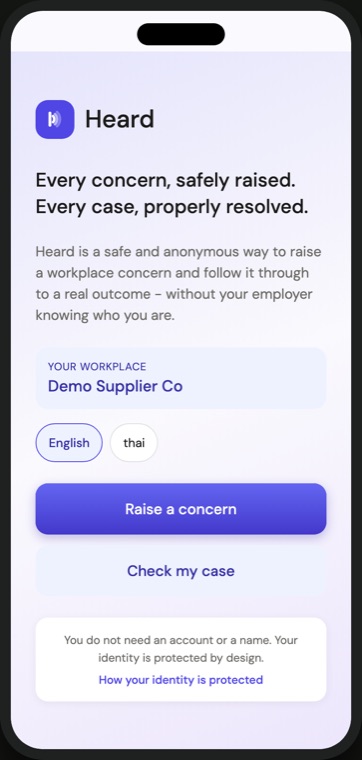
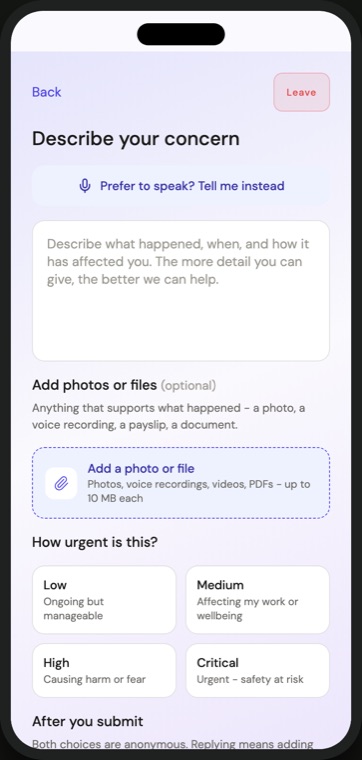
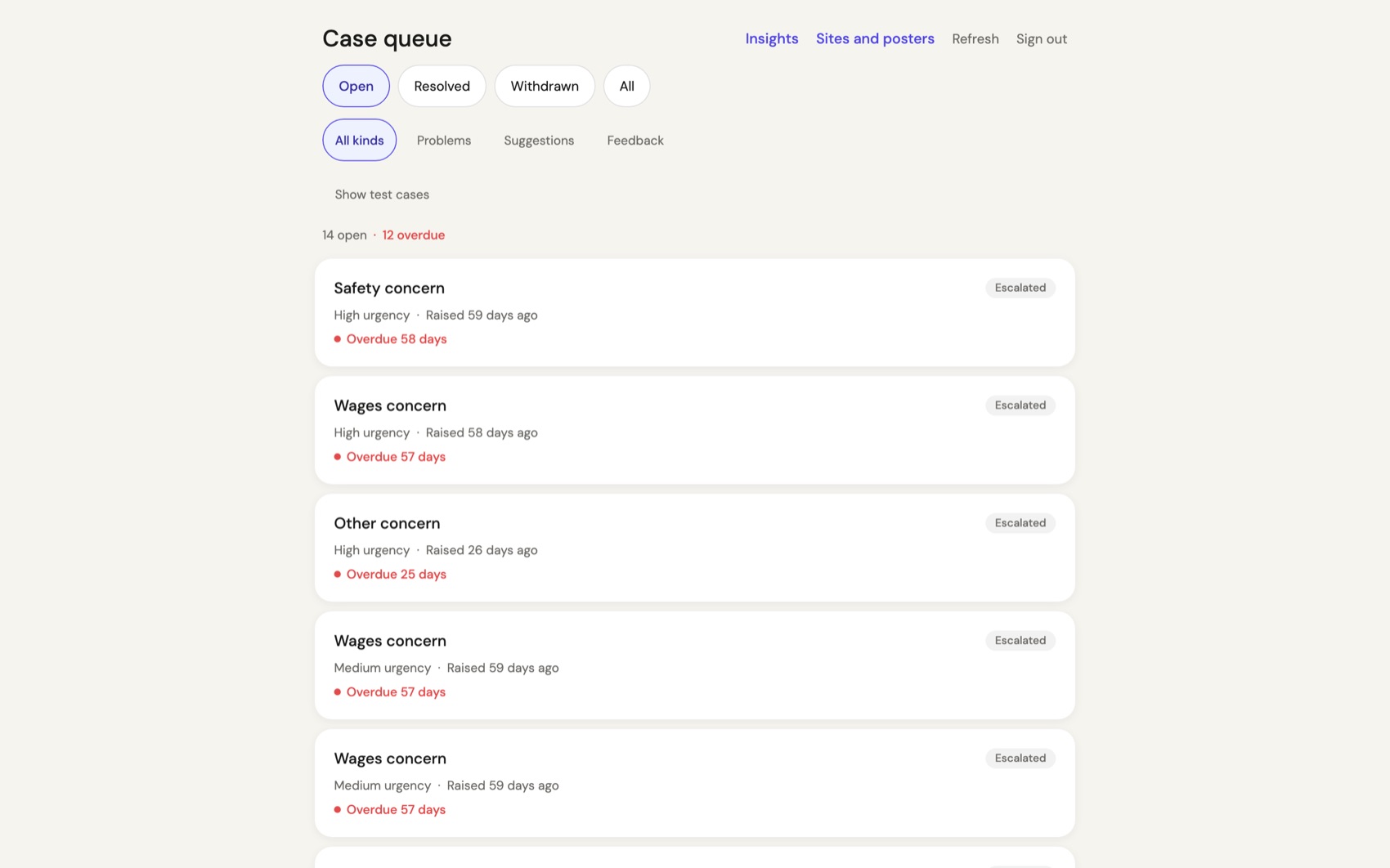
Screens from the running app. Demo data.
The design
Heard keeps no link between a case and a person.
Heard knows which workplace a case belongs to. It never knows who raised it, and it is built so that it cannot be made to know later.
- No worker account, no name, no phone number, and no device identifier stored with a case.
- The case code is shown once and never stored. Only a keyed hash of it is kept, so nothing on the server turns a case back into a person.
- Case bodies and any contact card are encrypted at rest, and files are stripped of hidden location and author data before they are stored.
- The audit trail is append only. A case history cannot be edited or deleted.
- Counted runs on a completely separate data store. A concern raised here can never be cross-referenced against a census answer there.
The case code
Three words, shown once.
This is the whole login system. It is given to the worker at submission and never written down anywhere on the server.
The worker proves the case is theirs by presenting those three words, which the server hashes and compares. A responder sees the case, the category and the conversation. A responder never sees the case code, and never sees who the worker is, unless the worker chooses to say.
The standard
Aligned to UN Guiding Principles, Principle 31.
The eight effectiveness criteria buyers and auditors use to judge whether a grievance channel is real or decorative. Heard is built to all eight, and the criterion by criterion mapping is a separate document.
Reading the results
Reading Heard's figures.
Low case volume measures trust, not conditions
In the first cycles it tells you whether workers know the channel exists, whether the poster is where they actually stand, and whether they believe speaking up is safe.
Watch the numbers you control
How quickly a case is acknowledged, how many breach the deadline, and whether workers who used it say the outcome helped. Those are visible from the first week, and they are what build the trust that raises volume later.
Are you a worker wanting to raise or track a concern?
Scan the Heard poster at your workplace, or type your workplace code into the app. If you already have a case, you will need the case code you were given when you raised it. You will not be asked for a name, a phone number or an account.
Where it fits
Heard on its own, and as one of four records.
Heard is built and deployable in its own right. A worker can reach it from a QR poster at any site, with or without a census. It reads the same way in any industry, and the sites it suits best are the ones with a contractor between the worker and the brand.
It is sold alongside its sibling Counted, and the two divide the work cleanly: the census surfaces the pattern, the grievance channel handles the individual case. The only link between them is a one way link at the end of a census, and no personal data crosses it.
Proof, Just Supply's assessment engine, weighs four records about a company: its payments on the rail, Counted's census, Heard's grievances and Declared's account of itself. The tier it publishes is the Just Supply Index.

Counted
The sibling product. An anonymous census that gives an organisation the pattern across a whole workforce.
See Counted ›
Declared
The company's account of itself, checked against the documents behind it. Proof reads it beside the workers' grievances.
See Declared ›Just Supply
The wider platform: a payment rail for supply chains, goods or labour, owned by the people in them, where the company's tier in the Just Supply Index sets what it pays.
The whole idea ›What to know before you deploy it
- Heard hears from whoever comes forward, which in a frightened workforce is very few people. It is sold with a census, which is how the pattern gets seen without anyone having to raise their hand.
- Heard handles the individual case and records what was done about it. It delivers where someone is ready to act on what comes back.
- A lost case code cannot be recovered. Heard never stores it, and workers are told so at submission.